

If NASA can achieve its ambitious goal, an entire fleet of moon landers and rovers would reach the lunar surface quickly during the coming years.
The organization said on Tuesday that it has given contracts to private space firms for future moon missions. This time, the contracts are for lunar landers that would deliver scientific equipment to the moon's surface in late 2028.
As NASA increases scheduled missions to the moon in order to establish a base there, the announcement is the most recent in a series of awards of a similar nature. In order to inform NASA's plans for lunar development, the different missions scheduled over the next two years will all aim to test technology and seek out places. For the first unmanned flights in its lunar base program, it announced a series of financial grants totaling around $1 billion last month. Over the following seven years, NASA intends to invest a total of $20 billion in the project.
The latest developments make it quite evident that NASA is committed to creating a long-term presence on the moon and plans to do so quickly, primarily through private partnerships.
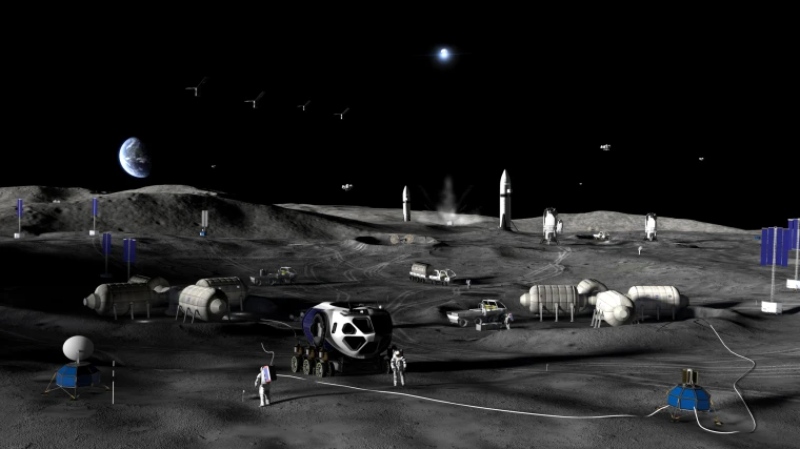
Conceptual Moon Base Phase Three development activities close to the lunar South Pole are depicted by an artist.
According to a statement from Lori Glaze, NASA's associate administrator for the Human Spaceflight Mission Directorate, "these new awards to our commercial partners, totaling nearly $600 million to land more missions on the moon with science payloads, demonstrate our commitment to accelerating our effort to build a long-term presence on the lunar surface and give us more opportunity to develop the skills we need to prosper there."
Isaacman also alluded to the possibility of repurposing a NASA Mars rover test version to be sent to the lunar surface on Tuesday
“Those that know our Mars rovers, Curiosity and Perseverance — well, there is another,” he said, adding that the test unit is named Promise. “I’d say we are thinking very hard right now about sending Promise to the moon.”
Two Texas-based businesses, Firefly Aerospace and Intuitive Machines, and Pennsylvania-based Astrobotic, which was already collaborating with NASA to develop a lander to carry more than 1,000 pounds of cargo and a moon rover to the lunar surface, possibly this year, are the three firms given new contracts for lunar landers.
According to NASA, Astrobotic was awarded a fresh contract worth $297.9 million to construct two more landers for the 2028 missions. This indicates that during the past six years, NASA has given it more than $600 million for its work on lunar gear.
NASA's Jet Propulsion Laboratory earlier awarded Firefly $75 million to construct four drones that will locate interesting locations in the moon's south pole.
According to NASA, none of the businesses are creating their landers from the ground up; instead, they are improving spacecraft that have already made space flights.
According to NASA, Firefly received $144.2 million and Intuitive Machines received $148.3 million.
According to NASA, Astrobotic was awarded a fresh contract worth $297.9 million to construct two more landers for the 2028 missions. This indicates that during the past six years, NASA has given it more than $600 million for its work on lunar gear.
NASA's Jet Propulsion Laboratory earlier awarded Firefly $75 million to construct four drones that will locate interesting locations in the moon's south pole.
According to NASA, none of the businesses are creating their landers from the ground up; instead, they are improving spacecraft that have already made space flights.
According to Isaacman, there have been serious talks about deploying the Promise rover, which is currently at the Jet Propulsion Laboratory in California, to research sites at the lunar south pole and look for resources there.
"We outfit it a little bit differently, put some different instruments on it, and it’s going to be a highly capable vehicle for the south pole of the moon,” Isaacman said. “And we can get it there fast versus any kind of new project.”
Additionally, Isaacman provided an update on the role of Jeff Bezos' Blue Origin. NASA had chosen Blue Origin to conduct an unmanned lunar surface mission this year alongside Astrobotic. However, during an engine test last month, Blue Origin's rocket blew up spectacularly, damaging its launch pad and casting doubt on its capacity to fulfill NASA's deadline.
According to Isaacman, the Blue Origin disaster will probably cause the moon trip to be delayed until next year.
Astrobotic's lander could potentially take off this year, according to Carlos García-Galán, NASA's moon base program manager.
According to Isaacman, NASA wants to give monthly updates on the lunar base missions. Additionally, the agency declared that it will be accepting ideas for science and technological payloads that could travel to the moon on the upcoming missions over the course of the next few months. Experiments pertaining to lunar energy infrastructure or communication systems, such as improved methods of transmitting data and messages between Earth and the moon, could be among the options.
CAPE CANAVERAL, Fla. (AP) — On Friday, a three-a..
Cryo-electron microscopy (cryo-EM) is providing cr..